Flaring Gas Is Becoming a Direct Cost
Many producers are paying for diesel power while usable associated gas is still being flared. As flaring, gas-disposal and compliance costs increase, stranded gas can no longer be treated as waste. It needs a practical route into field power and cash-flow improvement.
Diesel bills are rising
Remote producers often pay high fuel cost plus transport, storage and reliability risk.
Flaring is becoming chargeable
Gas that used to be treated as waste can now create recurring compliance and disposal cost.
Associated gas remains stranded
Energy molecules are available on site but not converted into commercial power output.
Waste gas becomes power
Modular gas-to-power infrastructure turns field gas into stable electricity and cash-flow improvement.
Associated Gas Is Becoming a Cost Center
Many producers are now paying on both sides: diesel for power generation and charges or handling cost for flared associated gas. The practical question is no longer whether the gas exists, but how quickly it can be converted into useful electricity and lower operating cost.
Paying for diesel
- Fuel prices and logistics cost remain high.
- Remote delivery creates schedule and reliability risk.
- Diesel dependence absorbs field cash flow every month.
Paying for gas disposal
- Flaring gas can create treatment, compliance or penalty exposure.
- Associated gas is still available as an energy feedstock.
- Modular power can convert this cost center into usable electricity.
The field cost equation
From Flare Gas to Field Power
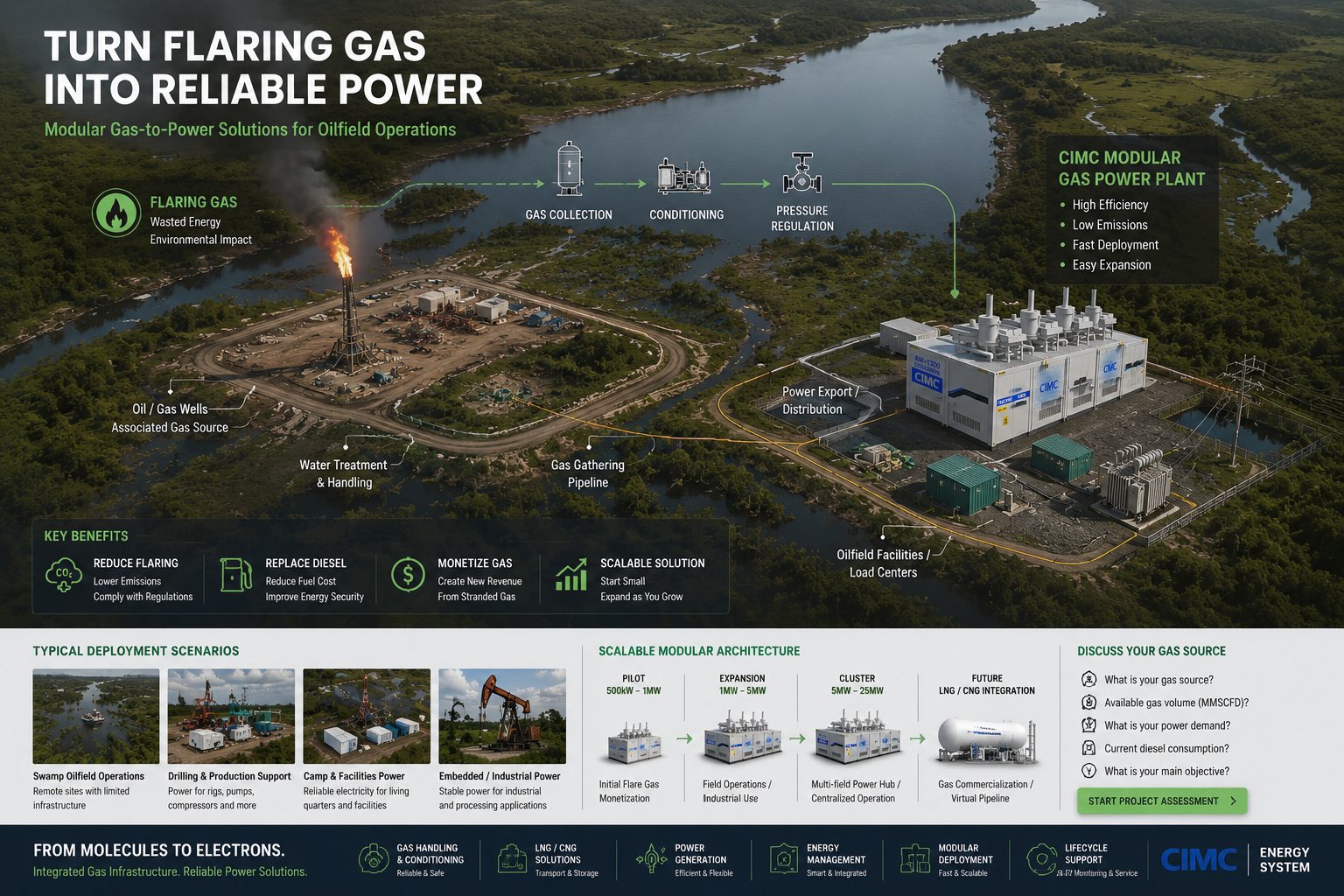
Use China-proven CIMC ENRIC modular infrastructure to collect, condition and regulate associated gas, then convert it into reliable power for oilfield loads or embedded industrial demand.
Why Modular Infrastructure Works in Africa
Fast Deployment
Containerized systems reduce civil work, support faster site installation and help producers react quickly when flaring cost or diesel exposure increases.
Lower Initial CAPEX
Start from smaller power blocks, prove field performance and expand progressively with actual gas availability.
Adaptable Gas Use
Suitable for field gas conditions where composition, pressure and production volume may fluctuate over time.
Easier Replication
Standardized modules simplify replication across oilfields, marginal fields and local energy network nodes.
Typical Deployment Scenarios
Built for oilfield operators, associated gas producers, marginal field owners, flare gas asset holders, embedded power developers and industrial energy investors.
Remote Oilfield Operations
- Drilling support
- Pumps and camp power
- Island mode operation
Diesel Replacement
Reduce diesel consumption and fuel transportation costs in remote operations.
Embedded Industrial Power
Deploy distributed gas power for industrial users near gas sources.
Future LNG / CNG Expansion
Build a scalable route toward LNG, CNG or virtual pipeline infrastructure.
Start Small. Expand Fast.
Build infrastructure progressively based on real operational data and gas availability.
| Phase | Typical Capacity | Scenario |
|---|---|---|
| Pilot | 500kW - 1MW | Initial flare gas monetization |
| Expansion | 1MW - 5MW | Industrial or field operations |
| Cluster | 5MW - 25MW | Multi-field power hub |
| Future | LNG / CNG integration | Gas commercialization |
Infrastructure Beyond the Generator
We support the route from gas handling to power dispatch, deployment packaging and future phased expansion.
Gas Side
- Gas handling
- Pressure regulation
- LNG/CNG integration
- Gas storage and transport
Power Side
- Modular gas gensets
- Synchronization
- PMS/SCADA
- BESS hybrid integration
Deployment Side
- Containerization
- Rapid delivery
- Remote monitoring
- Phased expansion
Swamp Associated Gas Power Deployment
A remote oilfield operation with stranded associated gas and high diesel dependency can deploy a modular gas-to-power system to reduce diesel consumption, utilize flare gas, support field operations and establish a scalable energy model for future expansion.
Discuss Your Gas Source
Share basic gas source, load and site information. Our team will review the most practical modular route for associated gas to power, flare gas monetization, embedded power or future LNG/CNG expansion.
Best fit for
- Oilfield operators and marginal field owners.
- Associated gas producers and flare gas asset holders.
- Embedded power developers and industrial energy investors.
- Local energy network nodes near gas sources.
Stop Paying Twice. Convert Gas Into Power.
Start with a modular deployment model and scale progressively based on operational performance and commercial demand.